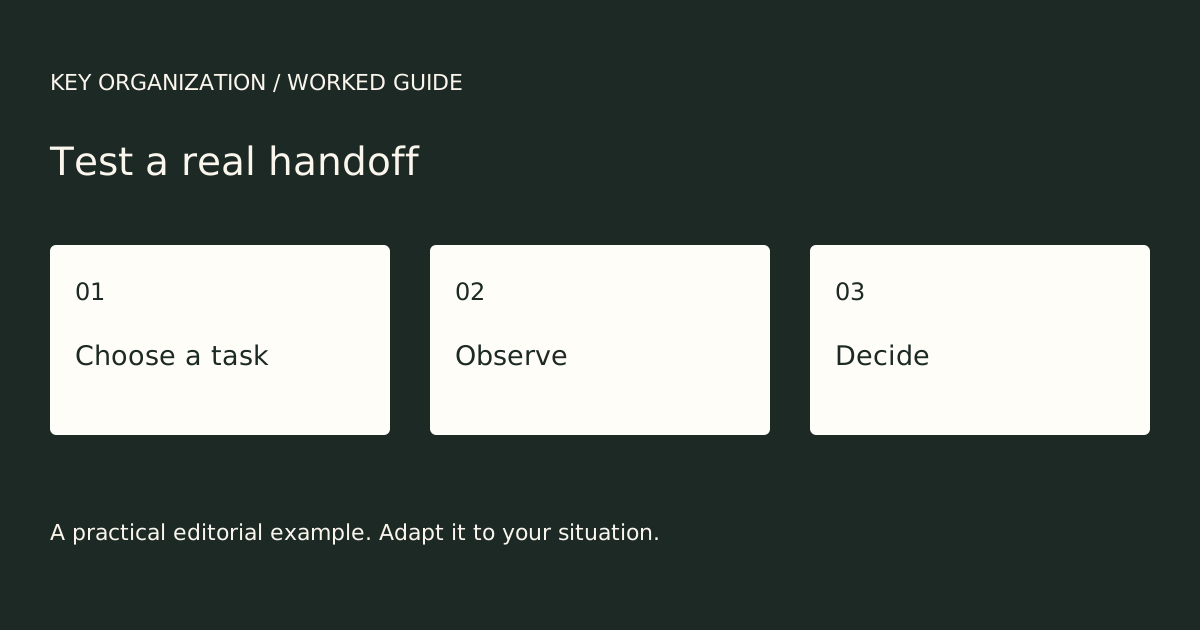
Start with the task, not the catalogue
A planner, book or filing application is a means of doing something. Write the job first: find a current document, remember a commitment, learn a method, or hand work to someone else. A list of features cannot tell you whether that job becomes easier in your setting.
This is an editorial decision exercise, not a ranking of products. It names no winning brand and quotes no current price. The steps, sample results and worksheet are newly written examples; they are not measurements from a customer trial.
Try one small, reversible task
- Describe the input. Choose a small set of non-sensitive sample information. For a planner, that might be one fictional deadline and its first action. For a file system, use a dummy project note.
- Define a visible result. Decide what another person should be able to locate or understand. Avoid a vague criterion such as “looks more organized”.
- Try the handoff. Ask an authorized person to find the agreed item using the instructions you would really give them. Record the point where the explanation becomes unclear.
- Test the exit. Check how you would keep a usable copy if you stopped using the system. Read the actual terms and export options of any product you consider; this guide does not verify them for a particular vendor.
For a book or course, make the trial a small technique you can explain and apply. For software, use the trial conditions actually offered; do not assume a trial is free, available or cancellable merely because an old page mentioned it.
Use evidence from the trial
| Criterion | Observation | Decision |
|---|---|---|
| Find the current note | A colleague opened the draft because two copies had similar labels. | Change the label and the link to the current version; then repeat the lookup. |
| Understand the handoff | The next action was missing from the note. | Write the action before comparing more features. |
| Keep a usable copy | The sample could be saved, but the link to its context was lost. | Test the saved copy and record the missing context. |
The new app has more features, but nobody can find the current note. Did the trial pass?
No: the chosen retrieval task is still failing. Improve the label, location or handoff and test that same task again. Extra features do not substitute for the result you set out to obtain.
Keep the decision explainable
Use the blank worksheet to record the job, sample input, observed result, access needs, exit route and next decision. Keep observations separate from promises made on a sales page. An unanswered question is a reason to investigate, not evidence that a tool is unsuitable for everyone.
Before any purchase, check the current seller, full cost, renewal and cancellation conditions yourself. This page supplies a comparison method, not current commercial terms or financial advice. You can run the exercise on a paper workflow as well as an application.
Keep the completed sheet with the decision so someone else can understand why the choice was made. Review it when the task or the people using the system change.
Use the blank worksheet
Download the blank worksheet (CSV)
The file is a plain table. You can also copy its headings onto paper or print this guide. Examples on this page are illustrative, not a record of a real person or household.
Sources, history and limits
New editorial guide: 18 October 2026. No named specialist review or measured outcome is claimed.
Historical Key Organization product catalogue — 11 May 2008 capture. Read on 18 October 2026.
The 2008 catalogue listed books, audio training and filing products. That archive establishes what the old site displayed at that time; it does not establish present availability, endorsements, prices or a relationship between those sellers and this edition. This page is a free decision guide, not an online shop. It does not process orders for those historical products.